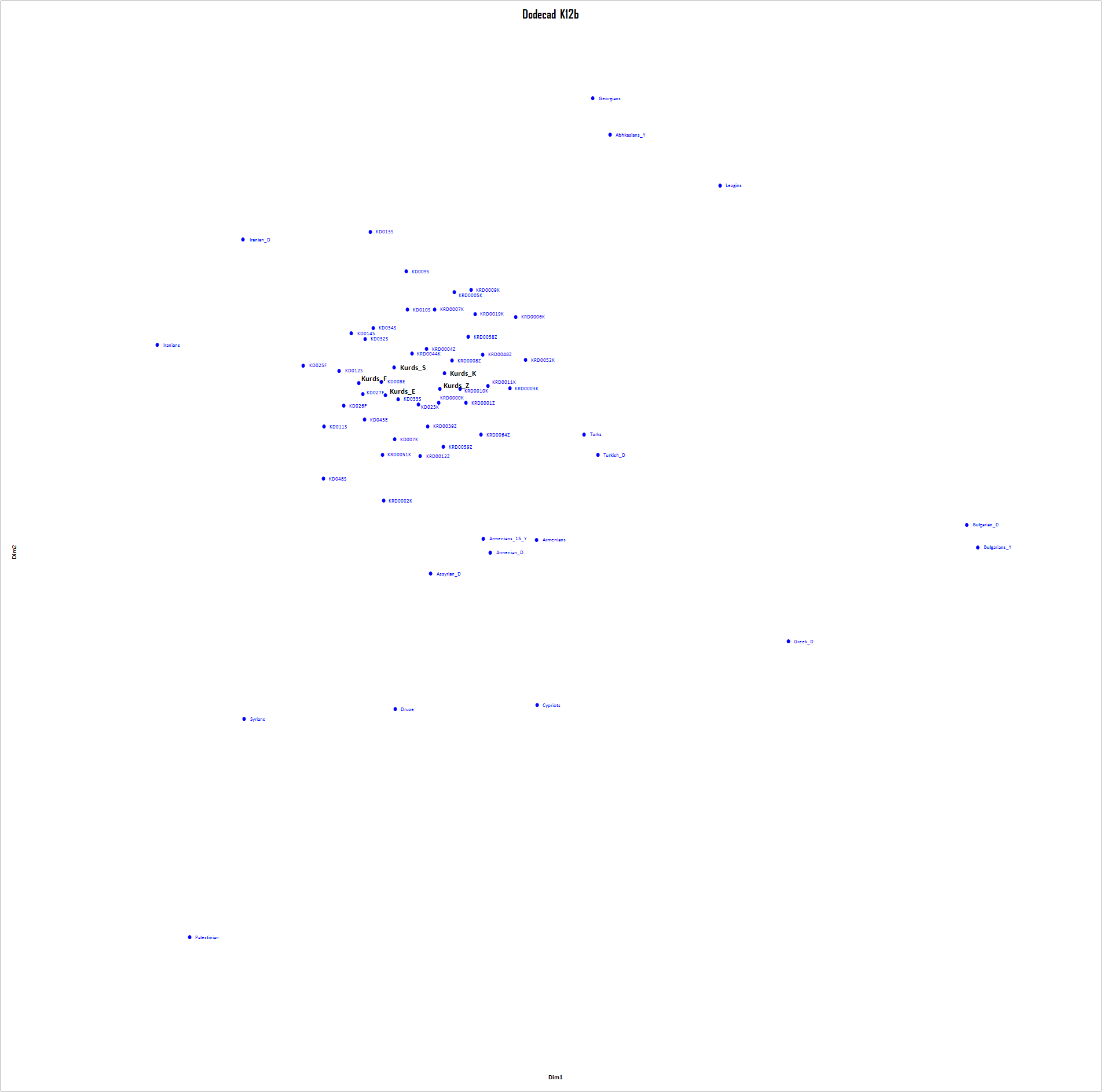
Revisiting Kurdish Autosomal DNA is updated with new 4 Zaza samples. Thought I should post participants distances to major Kurdish groups and individuals.
You can download the results here
Corduene.blogspot Participant Map
Friday, 19 September 2014

Sunday, 9 February 2014
Revisiting Kurdish autosomal DNA
Update: 19.09.2014
I thought I should merge all samples of KurdishDNA and this blog and try to shed some light on. Here's the total of 34 samples.
Ezidi: 2
Feyli: 3
Kurmanji: 15
Sorani: 10
Zazaki: 9
of samples
First all major subgroups' ADMIXTURE values from Dodecad K12b calculator.(Population Averages)
There is not much of difference between sub-groups other than expected gradual variation by the geography. Feylis score the highest Gedrosia+pseudo South Asian+lowest Mediterranean and Zazaki's highest Caucasus+lowest pseudo South Asian, Kurmanjis similar to Zazakis additionally have highest Atlantic-Mediterrean and North European components.
I thought I should merge all samples of KurdishDNA and this blog and try to shed some light on. Here's the total of 34 samples.
Ezidi: 2
Feyli: 3
Kurmanji: 15
Sorani: 10
Zazaki: 9
of samples
First all major subgroups' ADMIXTURE values from Dodecad K12b calculator.(Population Averages)

There is not much of difference between sub-groups other than expected gradual variation by the geography. Feylis score the highest Gedrosia+pseudo South Asian+lowest Mediterranean and Zazaki's highest Caucasus+lowest pseudo South Asian, Kurmanjis similar to Zazakis additionally have highest Atlantic-Mediterrean and North European components.
 |
Distances between dialect and religious sub-groups
There appears to be only 3 sub-groups when all samples are considered(n=34), #2 is a Kurdish exclave:
#1 Northern/Western (Kurmanji, Zazaki)
#2 Central Anatolian Kurds (Kurdên Anatoliya Navîn)
#3 Southern/Eastern (Ezidi, Sorani, Feyli)
(see Results by class: )
Reminder this North/South divide is more pronounced because of the sample bias. See my previous post about Participants Map, most northern samples are from Dersim and most southern samples are from Silêmanî. If there were more samples between those areas gradual difference would be much more finer.


| Kurds_F | Kurds_S | Kurds_E | Kurds_K | Kurds_Z | |
| Kurds_F | 0 | 2,809 | 2,243 | 5,920 | 6,047 |
| Kurds_S | 2,809 | 0 | 2,665 | 5,109 | 5,540 |
| Kurds_E | 2,243 | 2,665 | 0 | 5,788 | 6,250 |
| Kurds_K | 5,920 | 5,109 | 5,788 | 0 | 1,519 |
| Kurds_Z | 6,047 | 5,540 | 6,250 | 1,519 | 0 |
There appears to be only 3 sub-groups when all samples are considered(n=34), #2 is a Kurdish exclave:
#1 Northern/Western (Kurmanji, Zazaki)
#2 Central Anatolian Kurds (Kurdên Anatoliya Navîn)
#3 Southern/Eastern (Ezidi, Sorani, Feyli)
(see Results by class: )
Reminder this North/South divide is more pronounced because of the sample bias. See my previous post about Participants Map, most northern samples are from Dersim and most southern samples are from Silêmanî. If there were more samples between those areas gradual difference would be much more finer.
Distances between the class centroids:
| 1 | 2 | 3 | |
| 1 | 0 | 4,825 | 5,350 |
| 2 | 4,825 | 0 | 6,730 |
| 3 | 5,350 | 6,730 | 0 |
| Class centroids: | Class | 1 | 2 | 3 |
| Caucasus | 42,141 | 38,678 | 38,820 | |
| Gedrosia | 24,215 | 22,863 | 27,667 | |
| Southwest Asian | 13,323 | 14,265 | 14,865 | |
| Atlantic Med | 7,912 | 9,588 | 6,842 | |
| North European | 6,927 | 9,260 | 5,592 | |
| South Asian | 2,423 | 2,500 | 2,953 | |
| Siberian | 0,948 | 0,780 | 1,150 | |
| East Asian | 0,733 | 1,080 | 0,532 | |
| Southeast Asian | 0,316 | 0,130 | 0,355 | |
| Northwest African | 0,776 | 0,425 | 0,777 | |
| East African | 0,258 | 0,360 | 0,338 | |
| Sub Saharan | 0,063 | 0,000 | 0,105 |
| Results by class: | |||
| Class | 1 | 2 | 3 |
| KRD0000K | KRD0003K | KD008E | |
| KRD0001Z | KRD0010K | KD043E | |
| KRD0002K | KRD0011K | KD009S | |
| KRD0004Z | KD010S | ||
| KRD0005K | KD012S | ||
| KRD0006K | KD013S | ||
| KRD0007K | KD014S | ||
| KRD0008Z | KD032S | ||
| KRD0009K | KD033S | ||
| KRD0012Z | KD034S | ||
| KRD0019K | KD048S | ||
| KRD0039Z | KD026F | ||
| KRD0044K | KD027F | ||
| KRD0048Z | KD025F | ||
| KRD0051K | Kurds_F | ||
| KRD0052K | Kurds_S | ||
| KRD0058Z | Kurds_E | ||
| KRD0059Z | |||
| KRD0064Z | |||
| KD007K | |||
| KD023K | |||
| KD011S | |||
| Kurds_K | |||
| Kurds_Z | |||
 | |
|
Saturday, 8 February 2014
Participants Map
I've received a few values from Palisto and thought it would be better with using a map with all samples.
E: Ezidi
F: Feyli
K: Kurmanji
S: Sorani
Z: Zazaki
Monday, 3 February 2014
Kurdish Eyes

Updated: 08.09.2016
Only 23andMe V3 kits have been used.

and Maju's Map

Saturday, 12 October 2013
Further Investigation of Eurogenes K15
Davidski recently released the population averages and Fst distances I've been looking for, I did some cosmetics for easier reading.. You can check Kurdish and other West Asian populations..


I added the Northern Kurmanji and Zazaki samples i have into one Kurdish_A sample(n=9).. There is no significant differences between two samples.. Despite being generally Muslim Northern Kurds here appears to be the least Red Sea affected population other than Caucasians thanks to Taurus-Zagros mountain region.. And Eastern Eurasia influence on Northern Kurds is lower than overall Kurds.. There are also two major European clades; Mesolithic European(Atlantic, North Sea, Baltic, Eastern Euro) and Neolithic European(West Med) ancestry shared with West Asians.. Before explaining that here is a dendrogram I made based on Fst distances..
 |
| Cluster analysis based on Fst distances |
Red Sea is ancestral here for all Caucasoids.. South Asian and Southeast Asian appears to behave similar compared to Siberian being ancestral but opposite directions.. While South Asian is greatly affected by West Asian component, SEA is affected similarly by Austroloids..
As I mentioned above, Mesolithic European components cluster each other (while being differentiated how much they're affected by Neolithics and ancient Amerindian like peoples) and Neolithic West Med clusters with West Asians.. East Med here appears to be ancestral for West Med and West Asian components while Eastern Euro is ancestral of Mesolithic Europeans..
Now let's check the West Asian populations in this context.
Neolithic European here seems to correlate with R1b and Mesolithic European with R1a(in West Asia context).. Kurds here especially Northern Kurds seems to have the highest Mesolithic admixture after Turks and the least Neolithic after Iranians.
Last but not least here is a MDS plot I made with Kurdish samples I have.. Check KRD0000K is almost overlapping with reference sample thanks to being closest to overall Kurdish sample.. You can check other participants as well.. The results is a mirror of former Eurogenes Principal component analysis (PCA) of West Eurasia plot done by Davidski..
Kurds are between Anatolians and Iranians while streching between Causasus and Mesopotamia as their ancestral lands..
 |
| MDS plot of Europe-West Asia populations. Click here for bigger view. |
Subscribe to:
Posts (Atom)