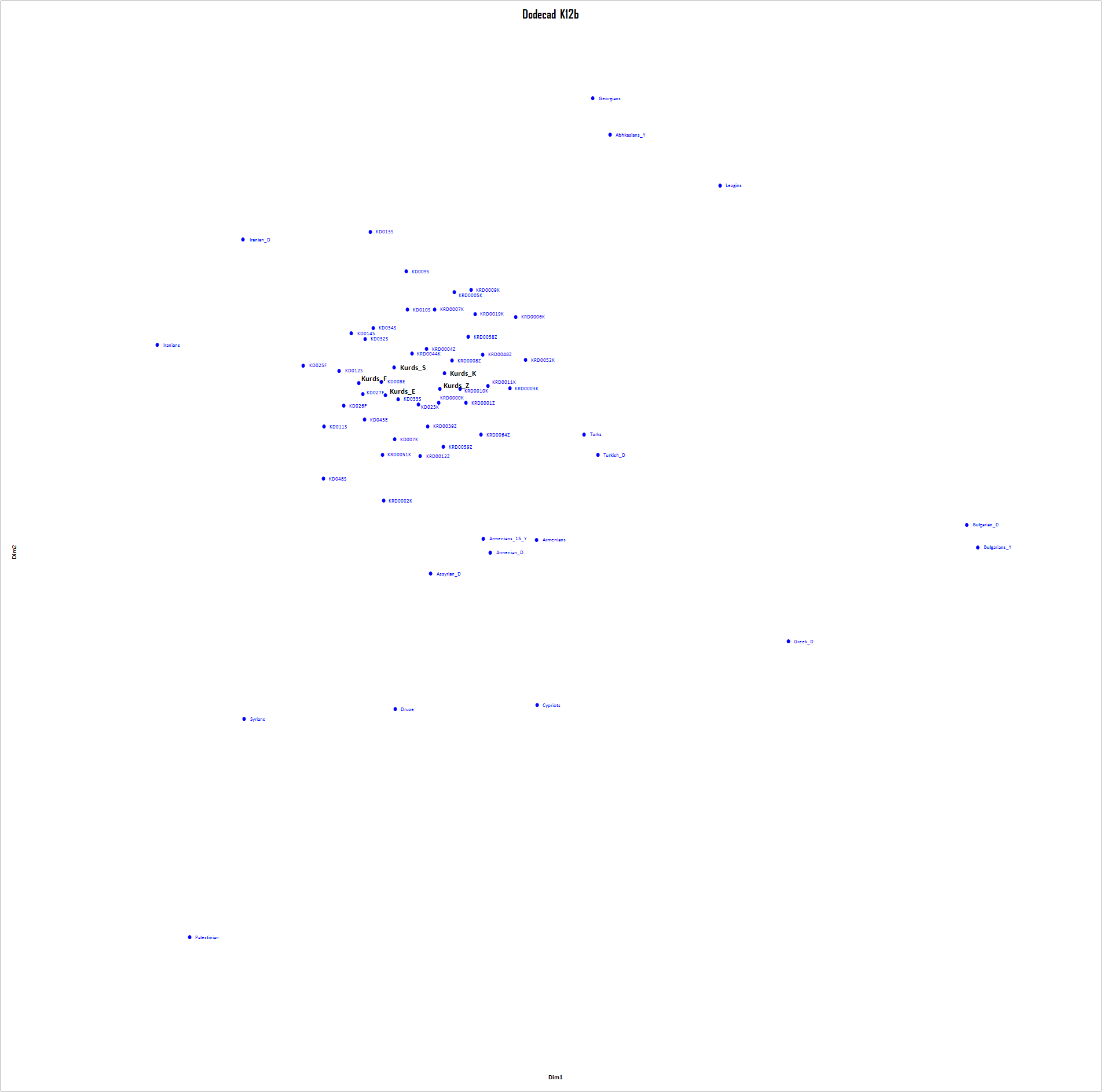
Today, I want to present Kurdish results using Eurogenes K13, presented on GEDmatch.com. Thanks to all the contributors of this post. This is an update of the previous experiment with using a different calculator and more individuals included. The calculator is supposed to be without calculator effect, thus it should present more clear results.
Kurdish sub-groups
Êzidî: 1
Feyli: 4
Kurmanji: 22
Sorani: 11
Zazaki: 18
Neighbouring peoples
Armenian: 20
Assyrian: 11
samples
ADMIXTURE results using Eurogenes K13. (Population Averages)
There is not much difference between sub-groups other than expected gradual variation by the geography. Overall they're pretty close. Feylis score the highest West+South Asian additionally the lowest West Med+North Atlantic. As shown at previous experiments, It is really hard to distinguish between Kurmanjis and Zazakis from overall admixture makeup so I'll take them as one. While Zazakis are just a hair lower, Kurmanjis score the highest North Atlantic+West Med and the lowest Red Sea, while Zazakis score the lowest South Asian, again Kurmanjis follow Zazakis just a hair behind. Kurmanjis, Soranis, Zazakis score similar level of Baltic admixture.
 |
Sorani = Central, Eastern, Southern
Kurmanji = Northern, North-eastern, North-western, Western, Far-western, additionally Central Anatolia and Xorasan exclaves
Zazaki = Far-Western, North-western, North-eastern, Western
Distances between Kurdish groups and their neighbours:
| Kurds_F | Kurds_S | Kurds_E | Kurds_K | Kurds_Z | Iranians | Armenians | Assyrians | Turkish | |
| Kurds_F | 0 | 3.9 | 4.1 | 4.6 | 4.5 | 3.1 | 13.3 | 13.6 | 14.9 |
| Kurds_S | 3.7 | 0 | 3.3 | 2.4 | 2.4 | 4.0 | 11.2 | 12.0 | 11.6 |
| Kurds_E | 4.1 | 3.3 | 0 | 3.5 | 2.9 | 5.6 | 9.9 | 10.9 | 12.7 |
| Kurds_K | 4.9 | 2.4 | 3.5 | 0 | 1.3 | 5.8 | 10.7 | 12.2 | 10.8 |
| Kurds_Z | 4.4 | 2.4 | 2.9 | 1.3 | 0 | 5.6 | 10.2 | 11.4 | 11.3 |
| Iranians | 3.1 | 4.0 | 5.6 | 5.8 | 5.6 | 0 | 13.9 | 13.8 | 14.2 |
| Armenians | 13.4 | 11.2 | 9.9 | 10.7 | 10.2 | 13.9 | 0 | 4.2 | 11.4 |
| Assyrians | 13.8 | 12.0 | 10.9 | 12.2 | 11.4 | 13.8 | 4.2 | 0 | 13.2 |
| Turkish | 14.9 | 11.6 | 12.7 | 10.8 | 11.3 | 14.2 | 11.4 | 13.2 | 0 |
Overall the closest people to Kurdish groups are their linguistic cousins, Iranians. Then Armenians, Assyrians, Turks. Syrians, Iraqis, Georgians are quite distant from Kurds hence excluded.
Despite having different religious beliefs and divided by international borders, Kurds are genetically quite homogeneous. When comparing Kurdish groups with their neighbours, there is no any sub clusters appear because of aforementioned reason. They all fall in the same cluster except a few admixed individuals. Therefore, We need to exclude neighbours to get finer details.
There are only 3 sub-clusters when all samples are considered(n=56). #2 seems like individuals with recent Armenian/-like ancestry. Thanks to more samples, this time division between clusters is finer and there is no clear cut borders like previous experiment. We can say first group is merely Northern or second group is merely Southern. Because both clusters have all Kurdish groups:
#1 Northern/Western
#2 Individuals with recent foreign admixture
#3 Southern/Eastern
(see Results by class: )
Distances between the class centroids:
1
|
2
|
3
|
|
1
|
0
|
7.1
|
4.4
|
2
|
7.1
|
0
|
7.0
|
3
|
4.4
|
7.0
|
0
|
Class centroids:
|
Class
|
1
|
2
|
3
|
North
Atlantic
|
3.9
|
3.7
|
2.5
|
|
Baltic
|
3.9
|
2.0
|
5.7
|
|
West Med
|
7.4
|
9.2
|
7.0
|
|
West Asian
|
40.4
|
38.1
|
37.5
|
|
East Med
|
29.1
|
34.8
|
30.4
|
|
Red Sea
|
5.1
|
4.3
|
6.1
|
|
South Asian
|
7.4
|
5.7
|
8.2
|
|
East Asian
|
0.4
|
0.3
|
0.3
|
|
Siberian
|
1.0
|
0.5
|
0.9
|
|
Amerindian
|
0.7
|
0.6
|
0.6
|
|
Oceanian
|
0.2
|
0.2
|
0.2
|
|
Northeast
African
|
0.4
|
0
|
0.3
|
|
Sub Saharan
|
0.1
|
0.6
|
0.3
|
Results by
class:
|
|||
Class
|
1
|
2
|
3
|
KRD000K
|
KRD002K
|
KRD003K
|
|
KRD005K
|
KRD012Z
|
KRD006K
|
|
KRD007K
|
KRD019K
|
||
KRD038K
|
KRD033K
|
||
KRD044K
|
KRD051K
|
||
KRD063K
|
KRD060K
|
||
KRD091K
|
KRD093K
|
||
KRD100K
|
KRD098K
|
||
KRD158K
|
KRD116K
|
||
KRD184K
|
KRD166K
|
||
KRD045E
|
KRD185K
|
||
KRD008Z
|
KRD001Z
|
||
KRD058Z
|
KRD004Z
|
||
KRD059Z
|
KRD039Z
|
||
KRD064Z
|
KRD048Z
|
||
KRD070Z
|
KRD077Z
|
||
KRD072Z
|
KRD078Z
|
||
KRD076Z
|
KRD086Z
|
||
KRD101Z
|
KRD029S
|
||
KRD102Z
|
KRD032S
|
||
KRD104Z
|
KRD047S
|
||
KRD030S
|
KRD061S
|
||
KRD031S
|
KRD089S
|
||
KRD138S
|
KRD092S
|
||
KRD192S
|
KRD148S
|
||
KRD036F
|
KRD034F
|
||
Kurds_E
|
KRD035F
|
||
Kurds_K
|
KRD090F
|
||
Kurds_Z
|
Kurds_F
|
||
Kurds_S
|
|||


Same dendrogram instead of ID codes, member's locations

 |
| Click image to expand |
Partly admixed individuals:
Euclidean distance:
KRD002K
|
KRD012Z
|
ARM13
|
ARM19
|
ASY08
|
|
ARM
|
6,2
|
6,0
|
4,9
|
6,8
|
5,1
|
ASY
|
8,9
|
6,7
|
7,3
|
8,3
|
4,6
|
Kurds_F
|
10,0
|
8,2
|
10,8
|
9,2
|
9,7
|
Kurds_S
|
8,1
|
7,0
|
8,5
|
7,4
|
8,1
|
Kurds_E
|
6,3
|
4,9
|
7,7
|
6,8
|
7,1
|
Kurds_K
|
6.9
|
7,0
|
7,4
|
6,7
|
8,3
|
Kurds_Z
|
6,7
|
6,1
|
7.0
|
6,0
|
7,5
|
Participant Map: